
To review an HA/HDA quotation against an air-quality requirement, keep the required class, measurement point and operating duty together. Ask what evidence covers every required contaminant at that point. A component list or micron grade leaves that review incomplete. The worked example below uses an assumed ISO 8573-1:2010 class 2:4:2 requirement to compare three fictional supplier responses; it does not recommend that class or certify an XMC treatment arrangement.
Keep the requirement separate from the proposed equipment
ISO 8573-1:2010 addresses compressed-air purity for particles, water and oil. [1] Record the document edition and the three requirements separately; the class order is particles, water, then total oil. [2] Begin with the equipment owner’s actual requirement, not a number selected from a filter brochure. A quotation should state whether it supplies individual components, a proposed treatment arrangement, or evidence for the delivered condition. Those scopes require different follow-up. The buyer needs to identify the open items before accepting the quotation, even if the mechanical interfaces already match.
Use one defined hypothetical purchasing brief
Assume the machine builder has specified class 2:4:2 for one inlet. The following values and document labels are invented only to make the purchasing review concrete. They are not a customer case, a recommended operating point or an XMC product rating. Keep the actual project’s requirement owner and approved revision in these fields. The flow-reference conditions describe the example demand value; they are not the operating pressure in the pipe.
| Field | Filled example |
|---|---|
| Required air condition | ISO 8573-1:2010 class 2:4:2, specified by the hypothetical machine builder. |
| Requirement point M1 | Machine inlet, after the final supply hose and before the machine’s internal components. |
| Duty for quotation review | 0.60 MPa gauge at M1; 20 °C air temperature; peak demand 300 L/min referenced to 20 °C, 100 kPa absolute and dry gas. |
| Operating scope | Normal production cycle. Startup and standby acceptance conditions are not yet agreed. |
| Lubrication permission | No intentional oil addition in the supply to M1, as an assumed machine requirement. |
| Acceptance ownership | Machine builder confirms requirements; plant-air supplier and test provider propose evidence and testing; buyer records unresolved items. |
Expand the class into the evidence fields you must review
The selected limits below follow Parker’s published summary of ISO 8573-1:2010. [2] They make the three parts of this assumed requirement visible; they do not reproduce all classification provisions. The responsible tester must use the complete applicable standard, including its particle-band definitions, reference conditions and measurement requirements. Keep the original class designation in the purchase specification rather than replacing it with this abbreviated table.
| Requirement | Selected limit from the published class table | Evidence field to keep open |
|---|---|---|
| Particle class 2 | Per m³: up to 400,000 in the 0.1–0.5 μm band; 6,000 in 0.5–1 μm; 100 in 1–5 μm. | Applicable particle results and classification basis, not merely an element’s micron label. |
| Water class 4 | Pressure dew point no higher than +3 °C. | Pressure dew point at the stated pressure and relevant duty; include the applicable liquid-water requirements in the test plan. |
| Oil class 2 | Total oil limit 0.1 mg/m³, covering liquid, aerosol and vapour. | Evidence covering the required oil scope, rather than an aerosol-only number presented as total oil. |
Compare what three fictional quotation replies actually close
The replies below are teaching examples, not quotations received from XMC or another supplier. They illustrate different evidence gaps without judging an installed product as passed or failed. Ask the supplier to tie its reply to AQR-01 and M1. A missing result is a missing result; it is neither zero contamination nor proof that the proposed equipment cannot work.
| Illustrative reply | What it supports | What the buyer still needs |
|---|---|---|
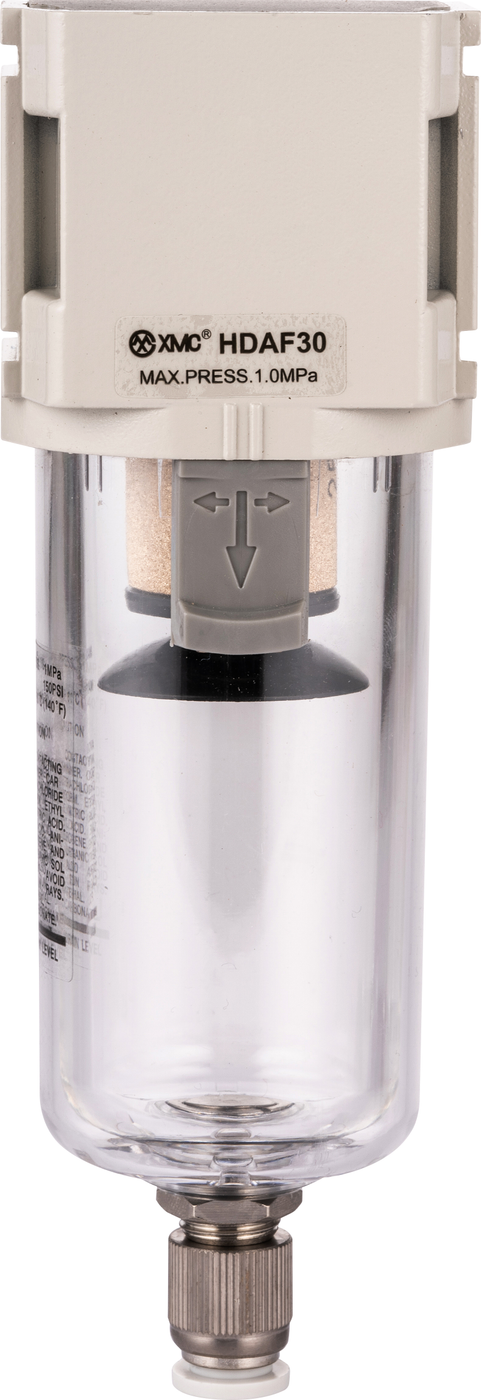
| A: “HDAF, 5 μm element” | A stated component/element proposal, subject to confirmation of its complete configuration. | Keep all three purity claims open. Request the proposed treatment scope and applicable evidence for M1. |
| B: “HDAF plus HDAFM, 0.3 μm” | A proposed filter and mist-separator combination. | Still no M1 particle classification, pressure-dew-point evidence or total-oil result. Ask who covers those requirements and any additional treatment. |
| C: A report covers particle results, pressure dew point and total oil, but its test point is S0 at the compressor-room outlet. | Evidence for the reported S0 location and recorded conditions, subject to technical review. | M1 is unresolved. Ask the responsible parties to assess the downstream path and provide an applicable M1 acceptance plan; do not relabel S0 results as M1 results. |
Read the XMC catalogue within its actual claim scope
The HDAF page lists 25 μm standard filtration with 5 μm and 50 μm options. The separate HDAFM page lists 0.3 μm and initially filtered compressed air. [4, 5] These entries support the component descriptions in replies A and B. They do not establish the complete class 2:4:2 condition at M1. Ask XMC to confirm the exact component configuration and its applicable performance evidence. Keep system-level treatment and testing responsibilities visible where the quotation does not cover them. Do not import another manufacturer’s purity performance into the XMC line items.
Ask for a test basis as well as a result
Parker’s testing paper explains that purity validation needs the relevant contaminant-measurement standards, not the class table alone. It distinguishes validation evidence from indicative checks. [3] Ask the test provider to identify the applicable methods, sampling arrangement, instrument scope and report conditions for this requirement. This article does not prescribe sample hardware, test duration or an acceptance uncertainty rule. Obtain those from the agreed technical procedure. If the offered oil result covers only aerosol, record the remaining total-oil question explicitly. If a dew-point value has no pressure basis, request clarification before comparing it with the brief.
Close the purchase review without claiming a test result
Keep a revision-controlled list of each open item, its responsible party and the evidence needed to close it. In this example, replies A and B need a treatment-and-evidence response; reply C needs a location-specific acceptance resolution. A supplier’s agreement to perform a future test is a commitment to a task, not a measured passing result. Attach the approved requirement, proposed arrangement and evidence scope to the quotation. Record any excluded duty, unconfirmed inlet condition or required downstream work before order release. When results arrive, have the responsible technical reviewer assess them against the agreed requirement and procedure.
Sources and limits of the worked example
ISO provides the standard scope; Parker’s publications support the class summary and the distinction between classification and testing. They do not certify XMC products. XMC facts are limited to the cited catalogue entries. AQR-01, M1, the operating inputs and all three replies are hypothetical. The example does not select a complete system or establish food, medical, breathing-air or sterile-service suitability.
Questions buyers ask.
Is class 2:4:2 the recommended air quality for every HA or HDA installation?
No. It is an assumed input for this purchasing example. Use the actual equipment or process requirement and have its owner confirm the applicable scope.
Can a 5 μm or 0.3 μm catalogue entry close this air-quality requirement?
No complete classification follows from that entry alone. Review evidence for each required contaminant, the specified measurement point and the operating conditions.
Can I accept a compressor-room report for a machine-inlet requirement?
Do not silently change the requirement point. Ask the responsible technical parties to evaluate what the report covers and how the machine-inlet condition will be established.
Should an unreported oil-vapour result be entered as zero?
No. Record the missing evidence and ask how the report addresses the required oil scope. An omitted value is not a measured zero.
Does agreeing a future test mean that the proposed system has passed?
No. Keep the planned test, actual results and technical acceptance decision as separate records. A quotation commitment is not a completed test result.
Technical references
- [1] ISO official catalogue, ISO 8573-1:2010, standard 46418. Abstract and publication status read 2 November 2026. Only scope is summarized; the full standard was not purchased or represented as fully reviewed.
- [2] Parker, Global Air Preparation System, catalogue PDE2676TCUK, printed page 12. Official PDF text read 2 November 2026; selected class 2 particle, class 4 water and class 2 total-oil limits used, not Parker equipment recommendations.
- [3] Parker, Compressed Air Purity (Quality) Testing: Validation to ISO 8573 Classifications or Indicative Testing?, WPCAQT-00-EN, printed pages 3–4. Official complete PDF downloaded and relevant pages visually read 2 November 2026; no detailed test procedure reproduced.
- [4] XMC Huayi Pneumatic Catalogue, edition 21 June 2025, printed page 52. Original customer spread and approved HDA extract visually read 2 November 2026 for HDAF element options.
- [5] XMC Huayi Pneumatic Catalogue, edition 21 June 2025, printed page 60. Original customer spread and approved HDAFM extract visually read 2 November 2026 for listed filtration and upstream medium. The purchasing brief and comparison replies are editorial hypothetical examples.
Put the guide to work.
Choose the relevant XMC series, download its product PDF and include the application details with your inquiry.